
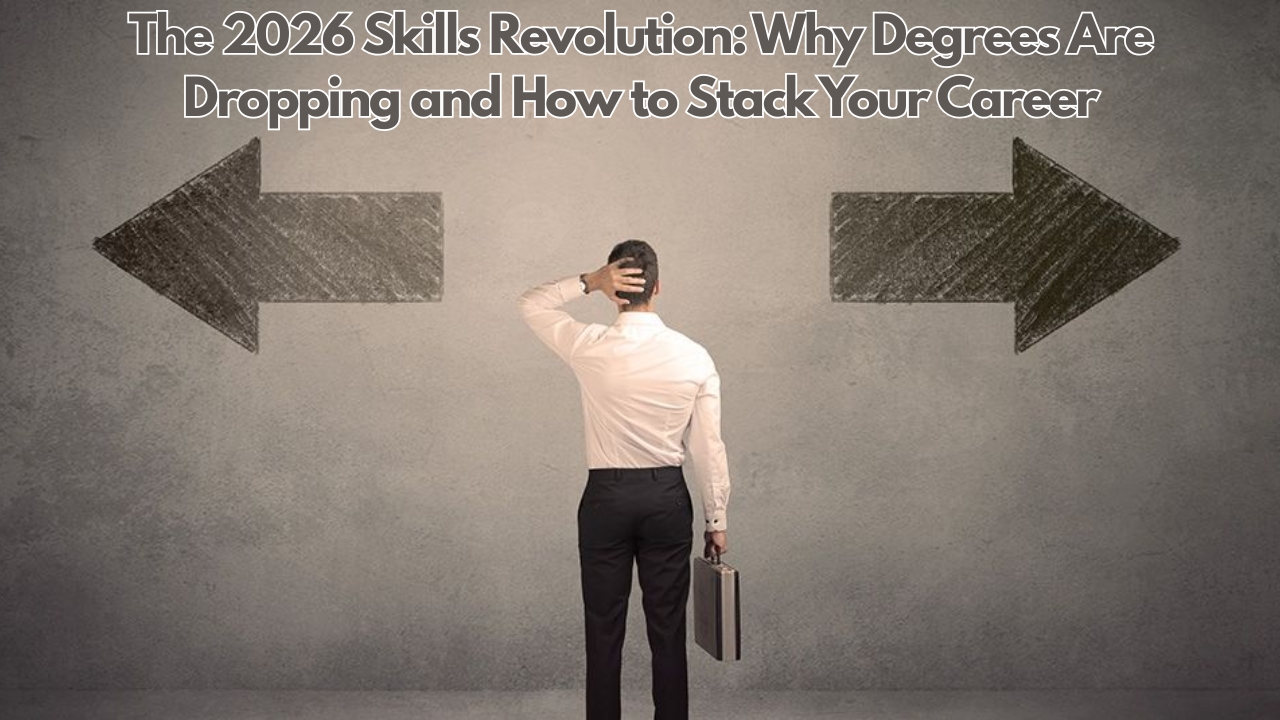
This shift is fueling the rise of skills-based hiring 2026, where demonstrable ability, certifications, and project experience outweigh formal education.

Introduction: The End of the Degree Monopoly
The global job market is undergoing a structural shift, and 2026 is shaping up to be the tipping point. Major companies like Google and IBM are no longer requiring traditional university degrees for many roles. Instead, they are prioritizing what you can do over what you studied.
The implication is clear:
A degree is no longer the default gateway to opportunity.
The solution? A new career strategy called Credential Stacking—the intentional combination of micro-certifications, practical AI experience, and niche fellowships to build a high-value, future-proof career.
The Essential 5 Skill Stack for 2026
To stay competitive in the era of skills-based hiring 2026, professionals must build a layered skill portfolio that blends technical competence with human intelligence.
1. AI Literacy and Prompt Engineering
Artificial intelligence is now foundational across industries. Understanding how to interact with AI tools, automate workflows, and generate insights is becoming a core skill.
Prompt engineering which is the ability to effectively communicate with AI systems is quickly becoming one of the most valuable competencies in the digital economy.
Professionals who can integrate AI into daily workflows will outperform those who cannot.
2. Human-Centric Soft Skills
While AI is advancing rapidly, it cannot replicate human depth in areas like:
- Empathy
- Ethical judgment
- Strategic thinking
- Leadership and communication
These skills are becoming more valuable, not less, as automation increases.
The future belongs to individuals who can combine AI efficiency with human insight.
3. Micro-Learning and Stackable Certificates
The debate around Micro-credentials vs Degrees is intensifying, with micro-learning emerging as the more agile and relevant option.
Platforms like Coursera and edX now offer stackable certificates that allow learners to:
- Specialize quickly
- Update skills continuously
- Build modular qualifications aligned with industry needs
Unlike traditional degrees, these credentials evolve with the job market.
4. Data-Driven Decision Making
Data is no longer reserved for analysts and scientists.
In 2026, professionals across roles like marketing, operations, finance, and leadership are expected to:
- Interpret data
- Extract insights
- Make evidence-based decisions
Understanding dashboards, metrics, and basic analytics tools is now a baseline requirement.
5. Cybersecurity and Digital Hygiene
As digital systems expand, so do vulnerabilities.
Every professional is now expected to understand:
- Basic cybersecurity principles
- Safe data handling practices
- Risk awareness in digital environments
Cybersecurity is no longer a niche field it is gradually becoming a universal competency.
Case Study: The Rise of the Modular Career

Consider two professionals entering the job market in 2026.
Traditional Path
- 4-year university degree
- Limited practical experience
- Generalized knowledge
Stacked Professional (Modular Career Path)
- 2-year diploma
- Google AI Certification
- Fellowship experience such as the Mila AI Institute Policy Fellowship
- Portfolio of real-world AI projects
The outcome?
The stacked professional is often:
- More employable
- More adaptable
- Better aligned with industry needs
The essence of stackable certificates is hinged on how they create a flexible, evolving career architecture.
Discover: 3 Shortcuts to a 2026 Promotion
If you want to accelerate your career within the skills-based hiring 2026 landscape, these global opportunities can fast-track your growth:
1. Hubert H. Humphrey Fellowship 2027
Hubert H. Humphrey Fellowship Program
A prestigious, fully funded program focused on leadership and professional development in the United States.
2. Einstein Fellowship 2026
Einstein Fellowship
Designed for innovative thinkers, this fellowship supports interdisciplinary research and creative problem-solving.
3. One Future World Conference 2026
One Future World Conference
A global platform for young leaders to collaborate, network, and gain exposure to international opportunities.
Final Thoughts
The future of work is no longer about static qualifications, it is about continuous skill evolution.
Skills-based hiring 2026 is not a trend; it is a transformation.
Degrees are losing their monopoly, and credential stacking is becoming the new standard.
For students, young professionals, and career switchers, the message is clear:
- Learn continuously
- Build practical skills
- Stack credentials strategically
- Combine AI competency with human intelligence
Those who adapt early will not just survive the shift but they will lead it.
