


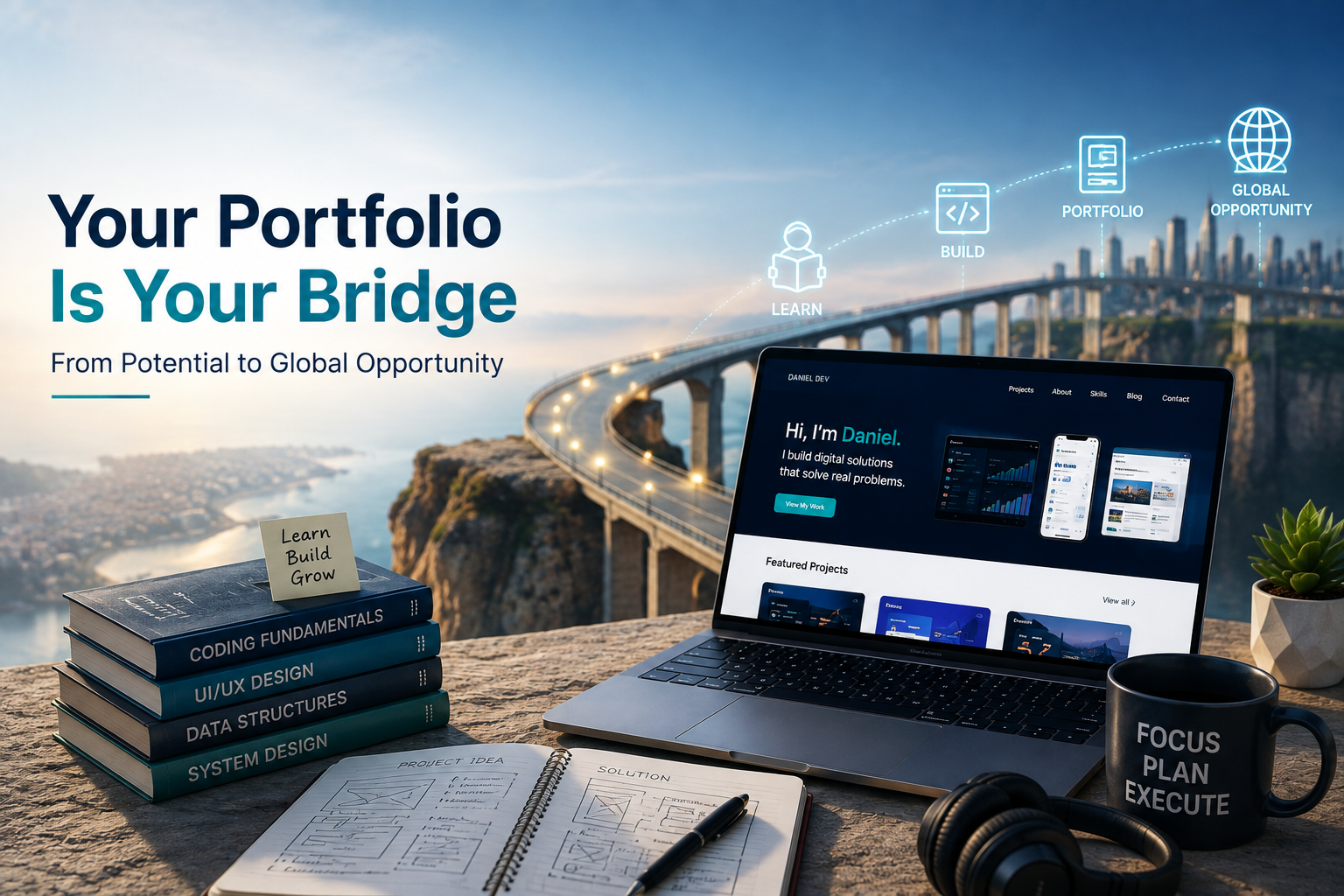
If learning the right skills is the foundation of a remote career, then your portfolio is the bridge between your potential and your first international opportunity.
Many students spend months completing online courses and collecting certificates but struggle to secure interviews because they cannot demonstrate what they can actually do.
A certificate may tell an employer that you completed a course.
A portfolio shows them that you can solve real problems.
For international recruiters hiring remotely, that difference is significant.
Your portfolio is often your first interview—even before you receive an email from a recruiter.
Phase 2: Build Proof, Not Just Knowledge
One of the biggest mistakes aspiring tech professionals make is confusing learning with building.
Watching tutorials is valuable.
Completing courses is important.
But employers hire builders.
They want to see evidence that you can apply your knowledge in practical situations.
Instead of asking yourself:
“How many courses have I completed?”
Ask:
“What have I built that demonstrates my ability to solve real problems?”
That mindset shift alone can dramatically improve your chances of standing out in a competitive job market.
Build Three Outstanding Projects Instead of Thirty Average Ones
A common misconception is that employers want to see dozens of projects.
In reality, most recruiters spend only a few minutes reviewing your work.
Three exceptional projects are far more convincing than thirty unfinished tutorial clones.
Aim to create projects that demonstrate:
- Technical competence
- Creativity
- Problem-solving ability
- Attention to detail
- Communication skills
- Understanding of user needs
Quality consistently outweighs quantity.
What Makes a Great Portfolio Project?
Your projects should solve genuine problems rather than simply replicate classroom exercises.
Instead of creating another generic “To-Do List” application, think about real challenges faced by individuals, businesses, or communities.
For example:
Software Engineering
Rather than building another calculator app, consider developing:
- A church management system
- A student budgeting application
- A healthcare appointment booking platform
- An inventory management system for small businesses
- A volunteer coordination platform
- A scholarship opportunity tracker
- A habit-building application
- An AI-powered meeting notes assistant
These projects demonstrate that you understand how software creates value.
UI/UX Design
Rather than designing random screens, redesign existing products that could be improved.
For example:
- Improve a banking app onboarding process.
- Redesign a government service portal.
- Create a better booking experience for public transport.
- Simplify a hospital appointment flow.
- Improve an e-commerce checkout process.
Recruiters love seeing thoughtful design decisions backed by research.
Artificial Intelligence
Instead of building a simple chatbot, create practical AI applications such as:
- AI document summarizer
- Resume optimization assistant
- Customer support assistant
- AI lesson planner
- Prompt library for businesses
- AI content workflow tool
Show how AI solves a measurable business problem.
Every Project Should Tell a Story
One mistake many students make is uploading screenshots without context.
International employers want to understand your thinking.
For every project, explain:
The Problem
What challenge were you trying to solve?
Who experiences this problem?
Why does it matter?
Your Research
How did you validate the problem?
Did you interview users?
Study competitors?
Read industry reports?
Test assumptions?
Your Solution
Explain your approach.
Why did you choose specific technologies?
Why did you make particular design decisions?
What alternatives did you consider?
Challenges You Faced
No project is perfect.
Recruiters appreciate honesty.
Discuss:
- Technical obstacles
- Design challenges
- Performance issues
- User feedback
- Lessons learned
This demonstrates maturity and critical thinking.
Results
Where possible, include measurable outcomes.
Examples:
- Reduced loading time by 40%
- Improved task completion rate
- Increased accessibility score
- Optimized database queries
- Improved usability through testing
Even personal projects can include meaningful metrics.
Make GitHub Work for You
For software developers, GitHub functions as a public portfolio.
Many recruiters review GitHub before scheduling interviews.
A strong GitHub profile demonstrates consistency, organization, and professionalism.
Keep Repositories Clean
Every repository should include:
- A clear README file
- Installation instructions
- Technologies used
- Project screenshots
- Live demo link
- License information
- Future improvements
Avoid repositories with confusing file structures or missing documentation.
Write Meaningful Commit Messages
Instead of writing:
- Update
- Fix
- Final version
- New changes
Write descriptive commits such as:
- Added user authentication with JWT
- Improved dashboard responsiveness
- Refactored API request handling
- Optimized image loading performance
Good commit history shows disciplined development practices.
Deploy Your Projects
Whenever possible, publish your applications online.
Useful platforms include:
- Vercel
- Netlify
- GitHub Pages
- Render
- Railway
Recruiters are far more likely to explore a live application than download source code.
Open Source Contributions: Your Secret Advantage
Many students believe open source is only for experienced developers.
The opposite is often true.
Open-source contributions demonstrate:
- Collaboration
- Communication
- Version control skills
- Teamwork
- Code quality
- Initiative
Even fixing documentation or reporting bugs can strengthen your profile.
How to Start Contributing
Begin with beginner-friendly repositories.
Look for labels such as:
- Good First Issue
- Beginner Friendly
- Help Wanted
As your confidence grows, contribute code, documentation, testing, or design improvements.
Open-source contributions often become excellent discussion points during interviews.
Build a Personal Brand Recruiters Can Trust
Your portfolio doesn’t exist in isolation.
Recruiters often search your name before making contact.
What they find influences their impression of you.
Your online presence should consistently reflect your professional interests.
Optimize Your LinkedIn Profile
LinkedIn is one of the most powerful platforms for attracting international recruiters.
Start with a professional profile photo and a headline that clearly communicates your expertise.
Instead of:
Student
Use something like:
Frontend Developer | React • Next.js • TypeScript | Building Accessible Web Applications
Or:
Product Designer | UI/UX • Figma • Design Systems | Creating User-Centered Digital Experiences
Your headline should describe the value you offer, not simply your current status.
Write an About Section That Sounds Human
Avoid generic phrases like:
I am passionate, hardworking, and self-motivated.
Instead, tell your story.
For example:
I’m a software developer passionate about building products that simplify everyday experiences. I enjoy solving practical business problems with modern web technologies and continuously improving through open-source collaboration and real-world projects.
Authenticity resonates more than clichés.
Share Your Learning Journey
You don’t need to wait until you’re an expert before posting online.
Share:
- Project updates
- Lessons learned
- Design decisions
- Coding challenges
- Interesting articles
- Open-source contributions
- Personal reflections
Consistency helps establish credibility over time.
Build Your Own Portfolio Website
Although GitHub and LinkedIn are valuable, a personal website brings everything together.
A clean portfolio should include:
- Brief introduction
- Featured projects
- Skills
- Resume
- Contact information
- Blog (optional)
Keep the design simple.
Recruiters value clarity far more than unnecessary animations.
Network Before You Need a Job
One of the biggest misconceptions about remote hiring is that applications alone secure opportunities.
Many successful candidates receive interviews because someone already recognizes their name.
Networking isn’t about asking strangers for jobs.
It’s about building genuine professional relationships.
Start by:
- Following engineering leaders.
- Connecting with designers.
- Engaging thoughtfully with posts.
- Participating in online communities.
- Attending virtual events.
- Joining hackathons.
- Contributing to discussions.
Over time, opportunities often emerge from relationships rather than cold applications.
Build Your Reputation Before Your Resume
Imagine two candidates applying for the same remote position.
The first submits a polished résumé.
The second submits a résumé, a portfolio with real projects, an active GitHub profile, thoughtful LinkedIn articles, and evidence of open-source contributions.
Which candidate is more likely to receive an interview?
The answer is obvious.
Before recruiters trust your résumé, they want to trust your work.
Your portfolio becomes the strongest proof of what you’re capable of delivering.
In Part 3, we’ll explore where to find legitimate remote USD-paying jobs, how to write an ATS-friendly résumé, prepare for technical interviews, communicate effectively with international employers, and significantly increase your chances of receiving job offers.
