
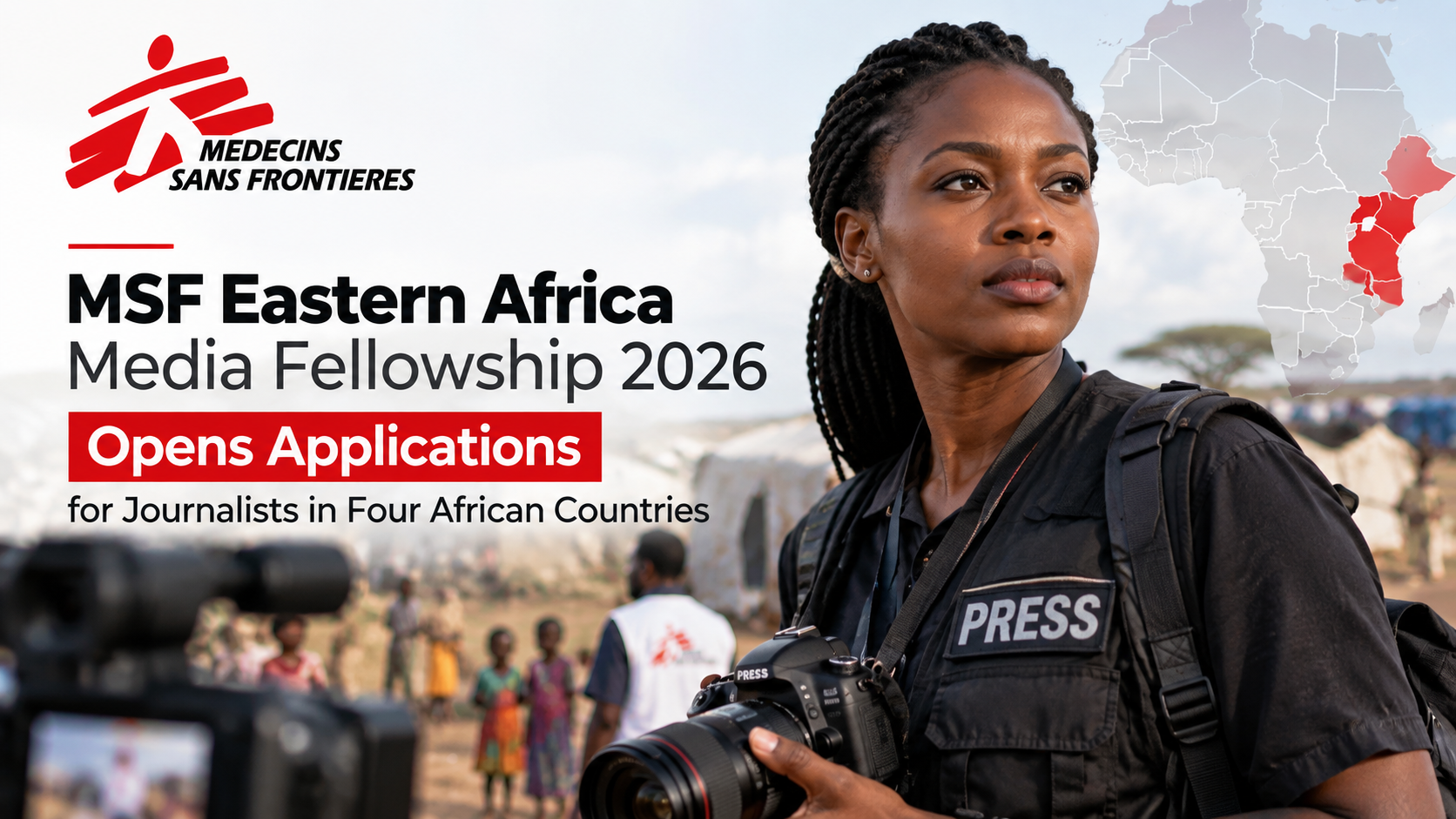
Journalists working in Eastern Africa who want to strengthen their reporting on health and humanitarian issues can use the MSF Eastern Africa Media Fellowship as an opportunity to develop specialised reporting skills and gain access to experts and MSF projects.
The fellowship is organised by Médecins Sans Frontières (MSF) Eastern Africa and is designed specifically for journalists who want to report on humanitarian and health issues affecting communities across the region.
The 2026 application period has now closed. However, the programme is worth understanding for journalists preparing for future editions.
Quick Facts
| Detail | Information |
|---|---|
| Fellowship | MSF Eastern Africa Media Fellowship |
| Organisation | Médecins Sans Frontières |
| Target group | Journalists |
| Region | Eastern Africa |
| 2026 countries | Kenya, Ethiopia, South Sudan and Tanzania |
| Experience | Minimum three years of journalism experience |
| Main support | Training, project access and reporting support |
| Application status | Closed |
| 2026 deadline | September 11, 2026 following an extension |
What Is the MSF Eastern Africa Media Fellowship?
The MSF Eastern Africa Media Fellowship supports journalists who report on humanitarian and health challenges in Eastern Africa.
The programme was launched in 2024 and has expanded beyond its original Kenya-focused edition.
Rather than being a conventional academic fellowship, it is designed around journalism, reporting and field storytelling.
Participants receive specialised training and can gain access to MSF projects and relevant experts to help develop stories about humanitarian issues.
Which Countries Are Covered?
The 2026 programme covered journalists connected to:
- Kenya
- Ethiopia
- South Sudan
- Tanzania
However, the eligibility rules differ between some country tracks.
For example, MSF states that applicants for the Ethiopia track must be Ethiopian nationals or based in Ethiopia, while applicants under the Tanzania track must be Tanzanian nationals or based in Tanzania.
The South Sudan track allows accredited journalists from Eastern African countries, subject to the relevant reporting requirements.
Applicants should therefore check the specific country track rather than assuming that being based somewhere in Africa automatically makes them eligible.
What Support Do Fellows Receive?
The fellowship provides several forms of professional support.
Participants can receive:
- Training from media and communication professionals
- Access to MSF projects
- Access to relevant experts
- Support for project visits
- A reporting grant to cover costs associated with approved project visits
This makes the programme different from a fellowship that simply provides classroom training.
The emphasis is on producing journalism based on reporting from the field.
Who Can Apply?
MSF’s general eligibility requirements include:
- At least three years of journalism experience
- A reference letter from the relevant editor
- Three recently published stories
- Affiliation with a media organisation, or appropriate regulatory accreditation for freelancers
- Commitment to travel for content collection
- Commitment to publishing within the fellowship timeline
Applicants may also need to demonstrate why their proposed reporting is relevant to their intended audience.
What Kind of Stories Does MSF Support?
The fellowship is built around humanitarian and health reporting.
The 2026 programme included different thematic areas depending on the country.
These included subjects such as:
- Maternal health
- Malnutrition
- HIV response
- Mental health
- Climate and health
- Refugee healthcare
- Sexual and reproductive health
- Sexual and gender-based violence
- Non-communicable diseases
- Community health
Applicants should review the current thematic tracks before developing a pitch.
The Application Is More Than a CV
One of the most important things prospective applicants should understand is that this is a storytelling and reporting fellowship.
Applicants are required to demonstrate their journalism experience and provide links to three published stories.
They also submit a letter showing their interest in one or more thematic tracks.
That means an applicant should think carefully about the story they want to tell rather than submitting a generic statement about wanting to become a better journalist.
How the Selection Process Works
The process has several stages.
Stage 1: Initial Application
Applicants submit their eligibility information, reference letter, published stories and relevant letter of interest.
Stage 2: Shortlisting
Selected applicants are invited to a full-day workshop.
Stage 3: Journalism Workshop
The workshop covers areas including pitch development, ethical reporting in sensitive contexts and impactful storytelling.
Stage 4: Refined Pitch
Participants refine their original story pitches using what they learned during the workshop.
Stage 5: Final Selection
MSF says the final pitches are assessed based on factors including:
- Quality
- Originality of the angle
- Feasibility of accessing the proposed story
- Relevance to the supported country programme
What Should Journalists Prepare?
For a future application, prepare the following well in advance:
- Updated CV
- Editor’s reference letter
- Three strong published stories
- Evidence of media affiliation or accreditation
- A clear area of reporting interest
- A preliminary story idea
- Evidence that you understand the audience for your proposed story
- Availability for travel and reporting activities
Freelance journalists should pay particular attention to the accreditation requirements.
A Practical Tip for African Journalists
Don’t choose a topic simply because it sounds important.
A strong reporting pitch should connect:
A real humanitarian issue
A clear human story
Access to credible reporting
A defined audience
A realistic reporting plan
For example, instead of proposing to broadly investigate “mental health in Africa,” a journalist could identify a specific community, healthcare challenge, affected population and reporting angle.
The more clearly the journalist can explain what they intend to investigate and why the story matters, the more useful the pitch becomes.
Current Application Status
The 2026 application period has closed.
MSF’s fellowship information initially listed September 8, 2026 as the deadline, while MSF Eastern Africa subsequently announced an extension to the end of September 11, 2026.
Applicants interested in future editions should monitor the official MSF Eastern Africa Media Fellowship page rather than relying on old deadlines published elsewhere.
Who Is This Fellowship For?
The programme is particularly relevant to journalists who:
- Already have professional journalism experience
- Cover health, humanitarian or social issues
- Want to strengthen field reporting
- Work in or report on Eastern Africa
- Can produce published journalism
- Are able to travel when required
- Have a clear story idea
It is not an entry-level journalism training programme for someone with no professional reporting experience.
Verification Note
Opportunities With Igbinovia reviewed this article against MSF Eastern Africa’s official fellowship information on September 28, 2026. The 2026 application period has closed. Requirements, countries, thematic tracks and deadlines may change for future editions.
Frequently Asked Questions
Is the MSF fellowship open to all African journalists?
No. The programme has specific Eastern African country and accreditation requirements.
Do applicants need journalism experience?
Yes. MSF’s general criteria require at least three years of journalism experience.
Can freelance journalists apply?
Freelancers may apply where they meet the relevant accreditation requirements.
Does the fellowship provide financial support?
MSF says the programme provides reporting support, including costs associated with approved project visits, along with training and access to relevant projects and experts.
Is this an academic fellowship?
No. It is primarily a professional journalism and reporting programme.
Final Takeaway
The MSF Eastern Africa Media Fellowship is best understood as a practical reporting opportunity rather than a conventional classroom fellowship. Its value lies in combining journalism training with access to humanitarian projects, experts and reporting opportunities.
Journalists interested in future editions should begin preparing their published work, professional references and story ideas well before applications open.
