


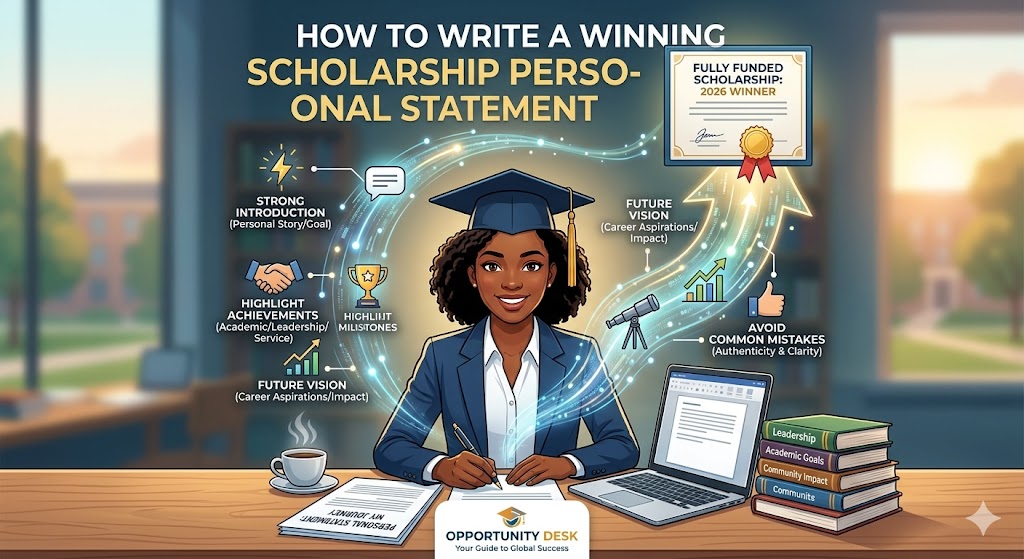
Your personal statement is the heartbeat of your scholarship application. While transcripts show your grades, the personal statement shows your humanity, ambition, and potential. In a sea of high-achieving applicants, a compelling narrative is often the deciding factor that moves your file from the “maybe” pile to the “winner” list.
This guide provides actionable scholarship personal statement tips to help you craft an essay that resonates with selection committees and secures your funding.
1. Hook the Reader with a Captivating Introduction
Scholarship committees read hundreds of essays. To stand out, your first paragraph must be “sticky.” Avoid starting with “My name is…” or “I am applying for this scholarship because…” Instead, try these high-impact openings:
- The Narrative Hook: Start in the middle of a defining moment. Describe the sights, sounds, or emotions of a specific challenge or realization.
- The Visionary Hook: State a bold belief or a specific problem in your community that you are determined to solve.
- The “Why” Hook: Explain the core motivation that drives your academic pursuit.
Pro Tip: Your introduction sets the tone. If you’re applying for a leadership scholarship, start with a moment where you had to make a difficult decision.
2. Showcase Achievements Through “Show, Don’t Tell”
Many students make the mistake of simply listing their CV in prose form. To write a winning scholarship essay, you must provide context and evidence.
- Academic Excellence: Don’t just say you are a top student. Mention a specific research project, a difficult concept you mastered, or how you applied classroom learning to a real-world problem.
- Leadership Impact: Focus on results. Instead of saying “I was the president of the student union,” say “As president, I initiated a peer-mentoring program that increased pass rates by 15%.”
- Community Service: Highlight your “why.” What did you learn from serving others, and how has it shaped your character?
3. Align Your Vision with the Scholarship’s Mission
A personal statement is a bridge between your past and your future. You must demonstrate that you are a high-return investment for the committee.
- Connect the Dots: Clearly explain how this specific scholarship—and the degree it funds—is the “missing link” to your career aspirations.
- The Ripple Effect: Describe the impact you will create after graduation. Will you influence policy? Build a business? Improve healthcare in a specific region?
- Specifics Matter: Avoid saying “I want to help people.” Say “I plan to develop sustainable irrigation systems for small-scale farmers in Northern Nigeria.”
4. Avoid the “Red Flag” Mistakes
Even the best stories can be undermined by common errors. Keep these scholarship essay guide rules in mind:
| The Mistake | The Fix |
| Generic Templates | Avoid “copy-pasting” from the internet. Committees can spot a template from a mile away. |
| Vague Statements | Replace “I am a hard worker” with a story about a time you worked 12-hour shifts while maintaining a 4.0 GPA. |
| Ignoring Word Limits | If the limit is 500 words, don’t write 501. It shows an inability to follow instructions. |
| Over-Modesty | This is not the time to be shy. Own your achievements with confidence and grace. |
Final Checklist for Success
Before you hit “Submit,” ensure your personal statement ticks these boxes:
- [ ] Authenticity: Does this sound like you, or who you think they want you to be?
- [ ] Clarity: Are your sentences concise and free of unnecessary jargon?
- [ ] Grammar: Have you proofread it at least three times (and had someone else look at it)?
- [ ] Theme: Does the essay have a consistent thread that ties your past, present, and future together?
Final Thoughts Writing a winning scholarship personal statement is about vulnerability and vision. By focusing on your unique story and demonstrating a clear path forward, you transform your application into a powerful case for your success.
