


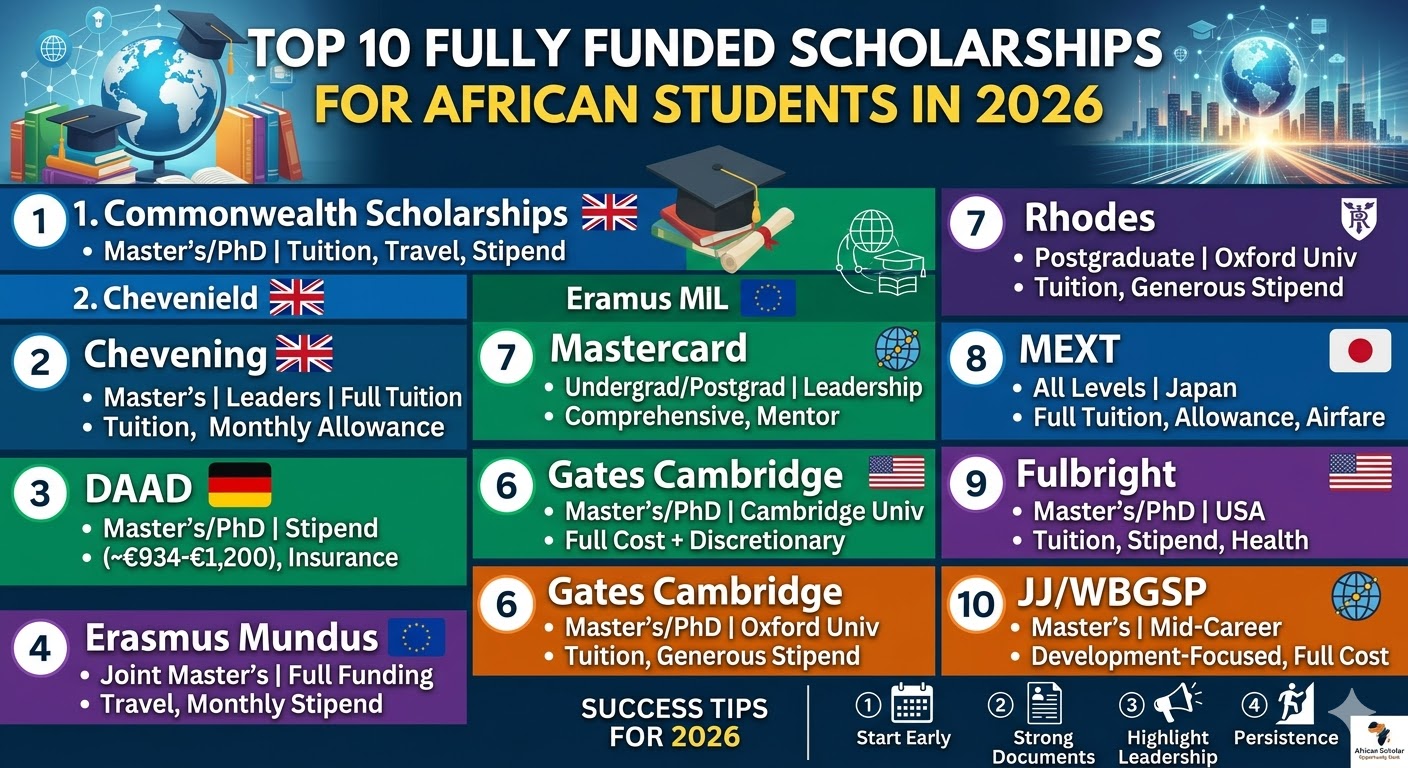
Are you an ambitious student from Africa dreaming of quality international education? The cost of tuition, accommodation, and travel can often feel insurmountable. Fortunately, prestigious, fully funded scholarship programs continue to level the playing field, offering life-altering opportunities in 2026.
This comprehensive guide details the Top 10 Scholarships for African Students in 2026, providing essential details on coverage, eligibility, and strategic application timelines to help you secure that competitive advantage.
Key Fully Funded Opportunities: Regional Leaders
1. Commonwealth Scholarships (United Kingdom)
- Target Audience: Citizens of Commonwealth countries in Sub-Saharan Africa.
- Study Level: Master’s and PhD studies.
- Key Benefits: Comprehensive coverage including full tuition, round-trip airfare, a monthly stipend, and an arrival allowance.
- Strategic Focus: These highly competitive awards prioritize academic merit and developmental potential, particularly in areas related to sustainable development goals.
2. Chevening Scholarships (United Kingdom)
- Target Audience: Emerging leaders from across Africa with strong networking and leadership potential.
- Study Level: One-year Master’s degrees at any UK university.
- Key Benefits: Full tuition fees (capped for MBA), a set monthly living allowance, and flights.
- Note: This UK government flagship program is uniquely aimed at candidates who demonstrate clear leadership potential and plan to return to their home country to implement change. The application window is typically narrow (August-November).
3. DAAD In-Country/In-Region Scholarships (Sub-Saharan Africa/Germany)
- Target Audience: African students focusing on Master’s and Doctoral studies.
- Study Level: Master’s and PhD.
- Key Benefits: This program is distinct. It often supports studies within top African “Centres of Excellence” (e.g., in Kenya, Nigeria, South Africa) or full studies in Germany, covering stipends, health insurance, and tuition.
- Focus Areas: Engineering, Natural Sciences, Agriculture, Public Health, and Education.
4. Erasmus Mundus Joint Masters (Europe-Wide)
- Target Audience: Top academic talents globally, including African nations.
- Study Level: Master’s degree only.
- Key Benefits: A truly international experience. The scholarship covers participation costs (including full tuition), a monthly stipend (~€1,000–€1,100), travel, and installation costs.
- Unique Structure: You study at least two different European universities in different countries, often resulting in a joint or multiple degree.
5. Mastercard Foundation Scholars Program (Global Partners)
- Target Audience: Academically talented African youth who have demonstrated commitment to leadership and community service and face significant financial barriers.
- Study Level: Secondary, Undergraduate, and Postgraduate (varies by partner university).
- Key Benefits: Comprehensive funding covering tuition, accommodation, books, stipend, leadership training, and often mentoring.
- Strategic Focus: The goal is to create ethical leaders. Applications are made through individual partner universities (which include institutions like UCT, Ashesi, Edinburgh, and select universities in North America and Europe).
Global Reach: Prestigious & Highly Specific Programs
6. Fulbright Foreign Student Program (United States)
- Target Audience: Young professionals and academics with potential in leadership and intercultural understanding.
- Study Level: Master’s and PhD research.
- Key Benefits: Tuition, stipend, health insurance, and travel.
- Focus: Cultural exchange is a significant component; applicants are expected to contribute to mutual understanding between the US and their home country.
7. Gates Cambridge Scholarships (United Kingdom)
- Target Audience: Outstanding applicants from outside the UK.
- Study Level: PhD or Master’s degrees at the University of Cambridge only.
- Key Benefits: Full cost of studying at Cambridge (tuition, maintenance, travel) plus discretionary funding for conferences.
- Criterion: In addition to academic excellence, leadership potential and a “commitment to improving the lives of others” are paramount.
8. MEXT Scholarship (Japan)
- Target Audience: Students wishing to study in Japanese universities.
- Study Level: Research Students (Master’s/PhD), Undergraduate, and College of Technology.
- Key Benefits: Full tuition, airfare, and a monthly allowance (~117,000 JPY or higher).
- Special Requirement: Knowledge of Japanese may be required for some programs, though many English-taught Master’s and PhD courses are available. Application is through the Japanese embassy in your country.
9. Rhodes Scholarship (United Kingdom – Oxford)
- Target Audience: Postgraduates with high integrity, leadership commitment, and exceptional intellect. Specific regional slots (West Africa, Southern Africa, East Africa) are allocated.
- Study Level: Postgraduate study (often multiple options over 2-3 years) at Oxford University.
- Key Benefits: All fees, plus a stipend (£19,000+ per annum).
- Criterion: Extremely competitive, emphasizing “moral force of character” and a potential for global impact.
10. Joint Japan/World Bank Graduate Scholarship (JJ/WBGSP)
- Target Audience: Mid-career professionals from developing countries, including many in Africa.
- Study Level: Master’s degree only.
- Key Benefits: Full tuition, health insurance, monthly stipend (~$1,800), and round-trip economy class tickets.
- Strategic Focus: Eligible programs are specified development-focused Master’s degrees (Economics, Public Health, Agriculture, Governance) in universities worldwide (often distinct from standard university admission).
Your 2026 Application Success Strategy
Scholarship committees consistently emphasize three critical factors:
1. Start Early (Timeline)
- September – November 2026 (For 2027 Entry): Peak application season for Chevening, Commonwealth, Gates Cambridge, and Rhodes.
- January – March 2026 (For 2026 Entry): Erasmus Mundus deadlines and the key window for the DAAD In-Region programs and the JJ/WBGSP.
2. Craft Compelling Documents
Your narrative must go beyond grades.
- Statement of Purpose (SOP): Don’t just list achievements. Explain your vision, why this specific degree and host country are essential, and the impact you intend to make upon returning to Africa.
- Letters of Recommendation: Seek mentors who know your work intimately and can speak to your academic potential and leadership qualities, not just confirm you were a good student.
3. Highlight Your Leadership Narrative
For highly competitive awards like Chevening, Mastercard, and Rhodes, demonstration of past leadership—whether in professional settings, university clubs, or community volunteerism—is vital. Committees look for evidence of problem-solving and positive community impact.
Final Thoughts on Securing Your Opportunity
The fully funded scholarship landscape for African students in 2026 remains robust but highly competitive. Success requires meticulous planning, a strong academic and leadership narrative, and persistence. By identifying the specific opportunities that align with your career goals and beginning your preparation today, you significantly enhance your chances of transforming your potential into global impact.
